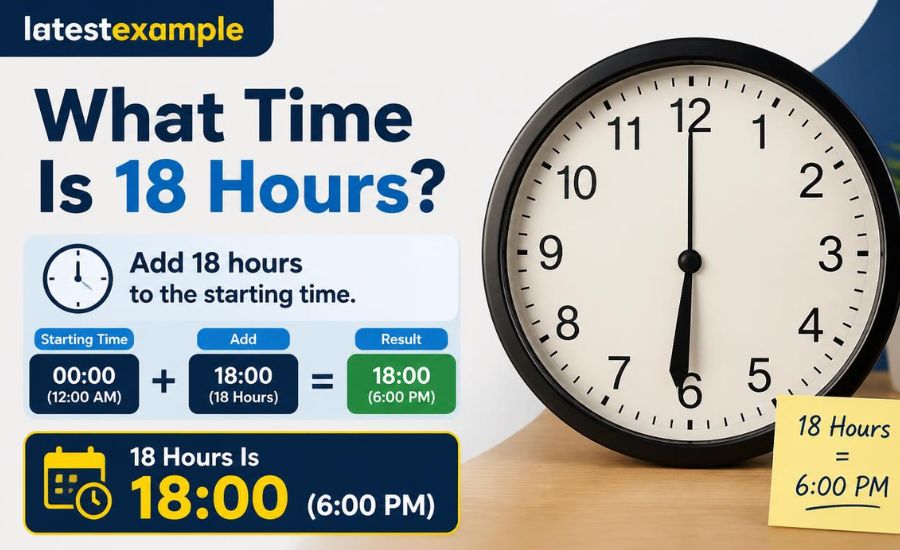
introduction
Knowing what time it will be 18 hours from now can help you plan appointments, manage deadlines, schedule work, track waiting periods, and organize daily activities. Although the calculation is straightforward, crossing midnight, changing dates, and converting between time zones can sometimes make the answer confusing.
The simplest way to calculate 18 hours ahead is to add 18 hours to the current time and adjust the date if necessary. For example, if the starting time is 10:00 AM, the result is 4:00 AM the following day. If it is 8:00 PM, the result is 2:00 PM the next day.
This guide explains how to calculate 18 hours from now manually, use the 24-hour clock, understand GMT+5, apply modular arithmetic, and avoid common mistakes. It also covers online calculators, real-life examples, useful facts, and frequently asked questions.
Related: 12 Weeks From Today: What Date Will It Be? A Simple Calendar Calculation Guide
How Can You Calculate 18 Hours From Now Manually?
To determine 18 hours from the present, you can perform simple addition. All that is required is to start by adding the hours to the present time.
What Are the Steps to Add 18 Hours to the Current Time?
Follow these steps:
- Identify the starting time, including AM or PM.
- Add 18 hours to the starting time.
- If the total reaches or exceeds 24:00 in a 24-hour representation, subtract 24 hours and advance the date by one day.
- Convert the final result to the 12-hour format if needed.
- Check whether the date has changed.
- For example, start at 9:00 AM.
- Add 12 hours to reach 9:00 PM.
- Add the remaining six hours to reach 3:00 AM.
- The result is 3:00 AM the following day.
This method works well for whole-hour starting times. If the starting time includes minutes, keep those minutes unchanged when adding exactly 18 hours.
What Time Will It Be in 18 Hours If Midnight Is Crossed?
When adding 18 hours takes the clock past midnight, the final time belongs to the next calendar day. Midnight is represented as 12:00 AM in the 12-hour system and 00:00 in the 24-hour system.
For example, adding 18 hours to 4:00 PM produces 10:00 AM the following day. The calculation passes midnight because only eight hours remain until midnight, leaving another ten hours to add.
How Does Adding 18 Hours Change the Date?
The date changes whenever the calculated time passes midnight. If you begin on October 16 at 8:00 PM, the result is October 17 at 2:00 PM.
If you begin at 2:00 AM on October 16, however, adding 18 hours gives 8:00 PM on October 16. The date remains the same.
When calculating deadlines, bookings, or reminders, write the complete result rather than just the clock time. “2:00 PM tomorrow” is more informative than “2:00 PM” when the event takes place on the next day.
What Happens When 18 Hours Extend Into the Next Day?

If the calculation crosses midnight, continue counting from 12:00 AM on the next day. For instance, from 10:00 PM, two hours take you to midnight, and the remaining 16 hours take you to 4:00 PM the next day.
The same principle applies when the starting point is close to the end of a month or year. If the calculation crosses December 31, the resulting date may be January 1 of the following year. The number of hours does not change, but the calendar date does.
How Do You Calculate 18 Hours From Now Using the 24-Hour Clock?
The 24-hour clock represents time from 00:00 to 23:59, making it particularly convenient for calculations. It avoids the need to distinguish between AM and PM.
For 18 hours ahead, add 18 to the initial hours. When the total is 24 or more, subtract 24 and progress to the next date.
For example:
- Starting time: 14:00
- Add 18 hours: 14 + 18 = 32
- Subtract 24: 32 − 24 = 8
- Result: 08:00 the next day
How Is 12-Hour Clock Time Converted into 24-Hour Clock Time?
Use these basic conversion rules:
- 12:00 AM becomes 00:00.
- 1:00 AM through 11:00 AM retain their hour numbers.
- 12:00 PM remains 12:00.
- 1:00 PM through 11:00 PM become 13:00 through 23:00.
For example, 7:30 PM becomes 19:30. Adding 18 hours produces 37:30, which becomes 13:30 on the following day after subtracting 24 hours.
Examples of Things That Occur 18 Hours From Now
The answer depends on the starting time. These examples cover morning, afternoon, and evening situations.
What Time Will It Be in 18 Hours From Morning, Afternoon, and Evening?
- Morning example: If it is 8:00 AM, adding 18 hours gives 2:00 AM the next day.
- Afternoon example: If it is 1:00 PM, adding 18 hours gives 7:00 AM the next day.
- Evening example: If it is 7:00 PM, adding 18 hours gives 1:00 PM the next day.
- Late-night example: If it is 11:00 PM, adding 18 hours gives 5:00 PM the next day.
How Does the Starting Time Affect the Final Result?
The starting time determines both the final clock time and whether the date changes.
A useful shortcut is to subtract six hours from the starting clock time and move the result one calendar day forward. For example, 10:00 AM minus six hours is 4:00 AM; moving forward one day gives 4:00 AM tomorrow.
This shortcut works because 18 hours equals 24 hours minus six hours. It is especially useful when the starting time is easy to read and the calculation involves a whole number of hours.
How Can You Use an Online Hours-From-Now Calculator?
An online calculator can add hours to a date and time automatically. It is useful when you need a precise future date, are working with multiple time units, or want to verify a manual calculation.
The Date and Time Calculator provided by timeanddate.com allows users to enter a starting date and time and add or subtract hours, minutes, seconds, and other units. Its instructions explain how to enter the starting point, choose the operation, and calculate the new date and time.
You can use the tool here: https://www.timeanddate.com/date/timeadd.html.
What Information Do You Need to Enter Into a Time Calculator?
For a straightforward calculation, you generally need:
- The starting date.
- The starting time.
- The number of hours to add—in this case, 18.
- The appropriate time zone, if the tool supports or requires one.
Select the correct date and time before calculating. If you are scheduling something across different countries, use a calculator that supports location-based time-zone conversion rather than relying only on a fixed clock offset.
Check the tool’s assumptions, particularly when daylight-saving changes or other local clock adjustments could affect the result.
Why Does Date Rollover Matter When Calculating 18 Hours Ahead?
Date rollover occurs when a calculation moves from one calendar day into another. It matters because a future time may fall on tomorrow, a different month, or even a different year.
For example, December 31 at 10:00 PM plus 18 hours becomes January 1 at 4:00 PM in the following year.
Ignoring date rollover can cause mistakes with travel reservations, payment deadlines, medication schedules, online meetings, and shift handovers. A time such as 4:00 PM is incomplete when the date is also important.
The safest approach is to record both the final clock time and the calendar date. For international appointments, include the relevant time zone as well.
What Time Is It 18 Hours From Now in GMT+5?
GMT+5 means a clock time five hours ahead of Greenwich Mean Time. Pakistan Standard Time, commonly abbreviated PKT, uses UTC+05:00 throughout the year. The timeanddate.com entry for Pakistan identifies this offset and reports that Pakistan does not currently observe daylight-saving clock changes.
For example, if the starting time in Pakistan is 10:00 AM PKT, adding 18 hours gives 4:00 AM PKT the following day.
If the starting time is 8:00 PM PKT, the result is 2:00 PM PKT the following day.
The correct response to the question “What time will be 18 hours from now in GMT+5?”” depends on the precise starting time. GMT+5 identifies the clock offset; it does not provide a unique future time without that starting point.
How Do You Calculate 18 Hours Ahead in Pakistan Standard Time?
Use the current Pakistan Standard Time as your starting point and add 18 hours.
For example:
- Starting time: 16:00 PKT
- Add 18 hours: 16 + 18 = 34
- Subtract 24 hours: 34 − 24 = 10
- Result: 10:00 PKT the next day
Pakistan’s fixed UTC+5 offset makes this calculation straightforward for ordinary local-time planning. If you are comparing the result with another country, convert the resulting instant to that country’s local time separately.
How Do Time Zones Affect Future Time Calculations?
Time zones determine the local clock time used in different locations. The National Institute of Standards and Technology (NIST) explains that local times can be expressed as offsets from Coordinated Universal Time (UTC). For instance, UTC+5 means local time is five hours ahead of UTC.
If you add 18 hours in one location and then display the resulting instant in another location, the local clock reading may differ. That does not necessarily mean the elapsed interval has changed.
Daylight-saving rules can also affect local clocks. The Internet Assigned Numbers Authority (IANA) maintains the Time Zone Database, which records time-zone histories and rules used by many software systems. Governments can change these rules, so software needs updated data.
Why Can the Same 18-Hour Calculation Produce Different Local Times?
Imagine that an event is scheduled for a particular instant in UTC. People in different time zones will see different local clock readings for that instant.
For example, when UTC is 12:00, a location using UTC+5 displays 17:00. The two clocks show different times, but they refer to the same instant.
When daylight-saving transitions are involved, a local clock may skip forward or repeat an hour.
Therefore, when calculating an exact elapsed duration across such a transition, use a location-aware date-and-time tool or a reliable time-zone database rather than assuming that local clock readings always advance uniformly.
What Are the Real-Life Uses of Projecting Time 18 Hours Into the Future?
Calculating 18 hours ahead can support many everyday activities:
- Work schedules: Determine when a long shift or scheduled work period will finish.
- Travel planning: Estimate arrival-related times and coordinate with departure schedules.
- Appointments: Identify the date and time of a future meeting or reminder.
- Online events: Plan webinars, broadcasts, and remote meetings across time zones.
- Delivery tracking: Estimate a time 18 hours after a recorded status or event, when the relevant service uses that interval.
- Personal planning: Organize study sessions, household tasks, and rest periods.
An 18-hour calculation identifies a future time; it does not guarantee that a delivery, journey, or service will actually be completed by then. For real-world schedules, check the relevant provider’s confirmed timings.
How Can an 18-Hour Calculation Help With Work and Travel Planning?
For work, adding 18 hours to a recorded start time can help identify a future checkpoint or deadline. For example, a task beginning at 6:00 PM reaches the 18-hour mark at noon the following day.
For travel, calculations can help coordinate schedules, but flight durations, layovers, local time zones, and published departure or arrival times should be checked separately. An 18-hour duration is not the same thing as adding 18 to a destination’s local clock without accounting for time-zone differences.
How Does Waiting for 18 Hours Influence Human Perception of Time?
People do not always experience the passage of time in the same way. An 18-hour wait may feel short when someone is occupied with work, travel, or an engaging activity, but longer when they are waiting without much to do.
The time calculation will remain the same no matter how much the time felt. If a deadline is 18 hours away, the objective calculation identifies when it arrives; personal expectations and attention affect the subjective experience of waiting.
For practical planning, use a clock, calendar, or reminder instead of relying on how quickly time seems to pass. This section describes everyday experience rather than making a specific scientific claim about how all people perceive an 18-hour interval.
How Can One Get Future Time Stamp by Seconds or Minutes?
The conversion depends on the unit used by the system:
- Hours: add 18.
- Minutes: add 1,080.
- Seconds: add 64,800.
For example, a timestamp measured in seconds can be updated by adding 64,800. If the system stores milliseconds, add 64,800,000 milliseconds instead.
These calculations assume the timestamp represents elapsed time consistently. Displaying the resulting timestamp in a particular time zone is a separate conversion step. Calendar dates and local daylight-saving rules may affect how the instant appears on a clock, even when the elapsed interval is exactly 18 hours.
How Can You Avoid Errors When Crossing Midnight?
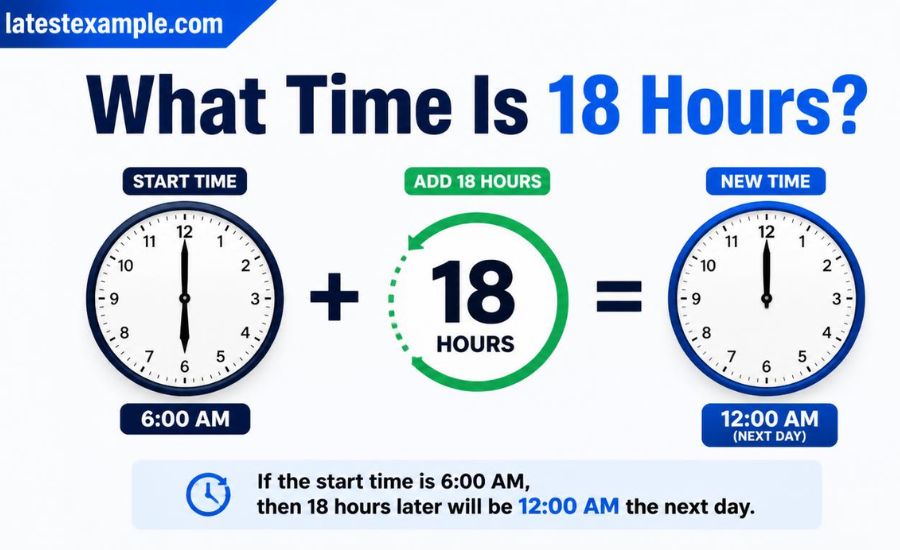
Use a consistent method:
- Convert the start time into the 24-hour system if needed.
- Add 18 hours
- Subtract 24 when the total reaches or exceeds 24.
- Advance the date when the calculation crosses midnight.
- Confirm the AM/PM conversion and time zone.
For important appointments or deadlines, verify the result with a date-and-time calculator. If a daylight-saving transition occurs in the relevant location, use a location-aware tool that accounts for the applicable rules.
What Tools Are There to Compute the Time in 18 Hours?
Several tools can help calculate future times:
- A phone clock or calendar: Useful for everyday scheduling and reminders.
- Computer Clock: Supplies the current local time, but you should verify the time zone that has been set.
- Date and Time Calculator: Adds hours to an initial date and time.
- A time-zone converter: Helps compare local times across different locations.
- A spreadsheet: Can calculate future date-time values using built-in date and time arithmetic.
- A programming language: Can calculate timestamps and format the results for software applications.
The appropriate tool depends on the task. For a simple calculation, manual addition is usually enough. For an international event or a timestamp spanning a clock change, use a tool that accounts for the relevant location and date.
What Is the Difference Between an Online Calculator and a Manual Calculation?
A manual calculation helps you understand the arithmetic and works well for straightforward situations. It is also useful when you need an answer quickly and know the starting time.
An online calculator can be more convenient when you need to include a specific date, several time units, or a time-zone conversion. However, you should check the tool’s settings and limitations. For example, timeanddate.com’s date-and-time calculator documentation distinguishes its standard date-and-time calculations from its location-aware time-zone tools.
Neither method can provide a unique answer if the starting time is unknown.Always start off with the right date, time, and time zone.
What Are the Key Points to Know for Computing 18 Hours From Now?
Here are the essential facts to remember:
- Eighteen hours equals 1,080 minutes.
- Eighteen hours equals 64,800 seconds.
- A standard 24-hour clock repeats its hour values after 24 hours.
- Adding 18 hours is equivalent to adding 24 hours and subtracting six hours.
- A calculation can end on the same date or the following date, depending on the starting time.
- Midnight is 00:00 in the 24-hour system and 12:00 AM in the 12-hour system.
- GMT+5 means five hours ahead of GMT; Pakistan Standard Time uses UTC+5.
- UTC provides a common reference for comparing times across different time zones.
- Daylight-saving transitions can change local clock readings in locations that observe them.
- The complete answer may require a date and time zone, not just a clock reading.
- These points provide a practical foundation for manual calculations and for checking results produced by online tools.
What Are Some Frequently Asked MCQs About Calculating 18 Hours From Now?
1. How many minutes are there in 18 hours?
A. 180 minutes
B. 720 minutes
C. 1,080 minutes
D. 1,800 minutes
Correct answer: C. 1,080 minutes
2. If the starting time is 8:00 AM, what time will it be 18 hours later?
A. 8:00 PM the same day
B. 2:00 AM the next day
C. 2:00 PM the next day
D. 6:00 AM the next day
Correct answer: B. 2:00 AM the next day
3. What is 18 hours after 7:00 PM?
A. 1:00 AM the next day
B. 11:00 AM the next day
C. 1:00 PM the next day
D. 7:00 AM the next day
Correct answer: C. 1:00 PM the next day
4. What is the 24-hour representation of 12:00 AM?
A. 00:00
B. 12:00
C. 24:00
D. 01:00
Correct answer: A. 00:00
5. How many seconds are there in 18 hours?
A. 18,000
B. 36,000
C. 64,800
D. 86,400
Correct answer: C. 64,800
6. What time is 18 hours after 2:00 AM?
A. 8:00 PM the same day
B. 8:00 AM the next day
C. 6:00 PM the same day
D. 12:00 AM the next day
Correct answer: A. 8:00 PM the same day
7. What does GMT+5 mean?
A. Five hours behind GMT
B. Five minutes ahead of GMT
C. Five hours ahead of GMT
D. The same time as GMT
Correct answer: C. Five hours ahead of GMT
8. Which formula calculates the future hour on a standard 24-hour clock?
A. Starting hour × 18
B. Starting hour + 24
C. (Starting hour + 18) mod 24
D. Starting hour − 24
Correct answer: C. (Starting hour + 18) mod 24
What Is the Summary of Calculating 18 Hours From Now?
To find what time it will be 18 hours from now, add 18 hours to the starting time and adjust the date if the calculation crosses midnight. You can perform the calculation manually, use the 24-hour clock, apply modular arithmetic, or check the result with an online calculator.
For example, 10:00 AM plus 18 hours equals 4:00 AM the next day, while 8:00 PM plus 18 hours equals 2:00 PM the next day. In Pakistan, use Pakistan Standard Time (UTC+5) when calculating local times. For international scheduling, consider the destination’s time zone and any applicable daylight-saving changes.
The most reliable habit is simple: calculate the time, confirm the date, and include the time zone whenever it matters. This approach makes 18-hour calculations easier to understand and helps prevent avoidable scheduling errors.
You will be also read about Measurement latestexample