introduction
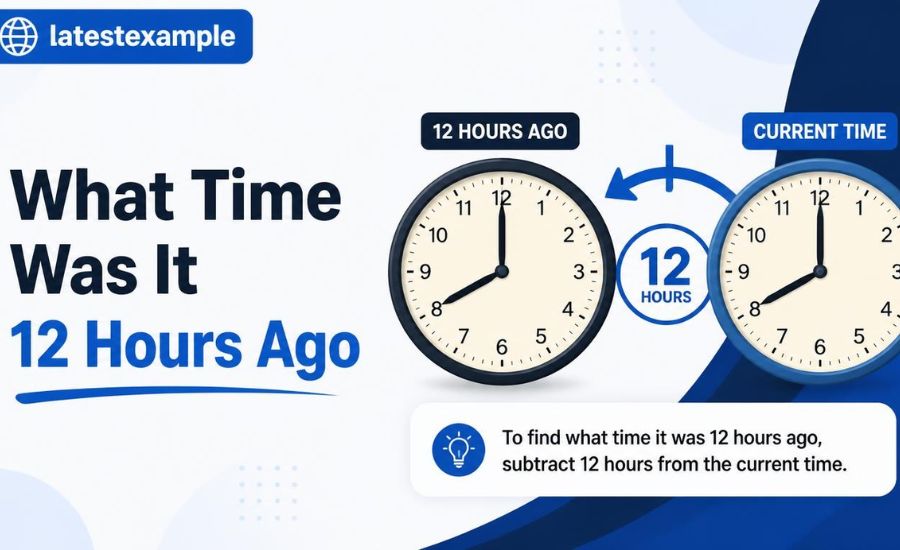
Finding out what time it was 12 hours ago is simple once you understand how the 12-hour and 24-hour clock systems work. In most situations, you only need to subtract 12 hours from the current time. However, the calculation can become slightly more confusing when it crosses midnight or changes the calendar date.
For example, if the current time is 8:00 PM, the time 12 hours earlier was 8:00 AM on the same date. If the current time is 8:00 AM, the time 12 hours earlier was 8:00 PM on the previous date.
This guide explains how to calculate 12 hours ago, understand the result in GMT+5, use a time calculator, and avoid common mistakes.
Related: 3 Weeks From Today Calculator: Get the Exact Date, Day, and Countdown
How Do You Find Out What Time It Was 12 Hours Ago?
To find the time 12 hours ago, subtract 12 hours from the current local time. Because 12 hours is exactly half of a 24-hour day, the result will normally show the same hour and minutes with the opposite AM or PM period.
For example:
- 7:00 PM becomes 7:00 AM.
- 10:30 AM becomes 10:30 PM on the previous date.
- 3:45 PM becomes 3:45 AM.
- 12:15 AM becomes 12:15 PM on the previous date.
The date is important. When the calculation moves backward across midnight, the answer belongs to the previous calendar day.
What Time Was It 12 Hours Ago on a 12-Hour Clock?

On a 12-hour clock, subtracting 12 hours produces the same hour and minute but switches the AM or PM designation.
For example, if the current time is 5:20 PM, the time 12 hours earlier was 5:20 AM. If it is 5:20 AM, the earlier time was 5:20 PM on the previous date.
This happens because a full day contains two 12-hour periods:
- AM refers to the time between midnight and just before noon.
- PM runs from midday until the time right before midnight.
Since 12 hours separates the two periods, the clock’s hour and minute display remains the same.
What Was the Time 12 Hours Before Wednesday, September 30, 2026?
Wednesday, September 30, 2026, is a useful example for understanding how the date affects a 12-hour calculation. The exact answer depends on the starting time.
These examples show why a date and time should be considered together. A morning starting time generally takes you back to the previous calendar date, while an afternoon or evening starting time usually produces an earlier time on the same date.
What Time Was It 12 Hours Ago in GMT+5?
GMT+5 is a time offset that is five hours ahead of Greenwich Mean Time. Pakistan Standard Time (PKT) uses UTC+5.
To calculate 12 hours ago in GMT+5, use the current local time in that offset and subtract 12 hours. You do not need to convert it to another time zone if your starting time is already in GMT+5.
For example:
- 8:00 PM GMT+5 becomes 8:00 AM GMT+5.
- 11:30 AM GMT+5 becomes 11:30 PM on the previous date.
- 12:15 AM GMT+5 becomes 12:15 PM on the previous date.
- 6:45 PM GMT+5 becomes 6:45 AM on the same date.
The GMT+5 offset does not change the basic subtraction rule. It identifies the local time being used for the calculation.
How Does a 12-Hours-Ago Calculator Work?
A 12-hours-ago calculator works by taking a starting date and time, subtracting 12 hours, and displaying the result. A basic calculator needs only the current time, while a more advanced tool may also use the date and time zone.
The calculation generally follows these steps:
- Read the current date and time.
- Identify the time zone being used.
- Subtract 12 hours from the starting time.
- Adjust the date if the calculation crosses midnight.
- Display the earlier time and date.
For example, entering Wednesday, September 30, 2026, at 9:30 AM produces Tuesday, September 29, 2026, at 9:30 PM, assuming the same time zone and no clock change during the interval.
A calculator is especially useful when you need an exact date, are working with different time zones, or want to avoid manual mistakes.
How Many Mnutes, Seconds, and Milliseconds Are in 12 Hours?
The calculations are:
- Minutes: 12 × 60 = 720
- Seconds: 720 × 60 = 43,200
- Milliseconds: 43,200 × 1,000 = 43,200,000
The National Institute of Standards and Technology (NIST) explains that the second is the international unit of time and is defined using a specific frequency associated with cesium atoms. These standard units make it possible to measure time intervals consistently.
What Time Will It Be 12 Hours From Now?
To find the time 12 hours from now, add 12 hours to the current time instead of subtracting them.
For example:
- 7:00 AM becomes 7:00 PM.
- 10:30 AM becomes 10:30 PM.
- 2:15 PM becomes 2:15 AM the following day.
- 11:45 PM becomes 11:45 AM the following day.
This is the opposite of calculating 12 hours ago. Both calculations usually keep the same hour and minutes while switching AM and PM.
Why Do the Date and Day of the Week Matter When Calculating 12 Hours Ago?
The date and day of the week matter because subtracting 12 hours can take you into the previous calendar day.
For example, if it is Wednesday at 8:00 AM, 12 hours earlier was Tuesday at 8:00 PM. If it is Wednesday at 8:00 PM, the earlier time was Wednesday at 8:00 AM.
This difference matters when calculating deadlines, work shifts, appointments, travel schedules, and event times. Recording only the clock time may not be enough when the date changes.
Always include the date when an exact historical time is important.
How Can You Verify a 12-Hour Time Calculation?
You can verify a 12-hour calculation by checking the starting time, subtracting the interval, and confirming that the result is exactly 12 hours earlier.
Use these methods:
- Check the clock format: Make sure you know whether the time is written in AM/PM or 24-hour format.
- Subtract 12 hours: Keep track of whether the calculation crosses midnight.
- Check the date: Confirm whether the answer belongs to the same day or the previous day.
- Check the time zone: Make sure both times use the same time-zone reference.
- Use a reliable clock: For precise timekeeping, NIST’s Time.gov provides a reference for official time information in the United States.
- For an ordinary calculation, checking the hour, minutes, AM/PM period, and date is usually enough.
What Are the Most Common Mistakes When Calculating 12 Hours Ago?
Although the calculation is simple, a few mistakes can lead to an incorrect answer.
1. Forgetting to change AM and PM
A common mistake is subtracting 12 but keeping the same AM or PM label. For example, 6:00 PM becomes 6:00 AM, not 6:00 PM.
2. Ignoring the previous date
If the current time is 7:00 AM, the time 12 hours earlier was 7:00 PM on the previous date.
3. Confusing midnight and noon
12:00 AM means midnight, while 12:00 PM means noon. Mixing them up can produce a 12-hour error.
4. Using the wrong time zone
A time recorded in GMT+5 cannot automatically be treated as a time in UTC or another local time zone. Convert the time zone first when comparing different locations.
5. Ignoring daylight-saving changes
Some locations move their clocks forward or backward during the year. When an interval crosses such a change, subtracting 12 hours of elapsed time may not produce a local clock reading that is exactly 12 numbers earlier. The U.S. Naval Observatory explains how daylight-saving adjustments affect local civil time.
What Is the Fastest Mental Method for Calculating 12 Hours Ago?

The fastest mental method is to keep the hour and minutes the same and switch AM to PM or PM to AM.
For example:
- 9:25 AM becomes 9:25 PM on the previous day.
- 4:10 PM becomes 4:10 AM on the same day.
- 12:40 AM becomes 12:40 PM on the previous day.
You only need to check whether the starting time is before or after noon to determine whether the date changes.
This approach is convenient for everyday calculations because it avoids lengthy subtraction.
Why Can 12 Hours Ago Fall on a Different Calendar Date?
A calendar day contains 24 hours. Therefore, going backward by 12 hours can cross midnight and move the calculation into the previous date.
For example, if it is Thursday at 5:00 AM, 12 hours earlier was Wednesday at 5:00 PM. The clock time is still 5:00, but the calendar date has changed.
By contrast, if it is Thursday at 5:00 PM, 12 hours earlier was Thursday at 5:00 AM. The result remains on the same date.
This is why an accurate answer should include both the time and the date whenever the starting time is close to midnight or in the morning.
When Should You Use a Time Calculator Instead of Mental Math?
Mental math is suitable for simple calculations, especially when you only need to find the opposite AM/PM time. A time calculator is a better choice when the calculation involves more details.
Consider using a calculator when:
- You need the exact date as well as the time.
- You are calculating a time interval across several days.
- You are comparing times in different time zones.
- The interval crosses a daylight-saving clock change.
- You are working with schedules, records, or deadlines where accuracy matters.
For international time calculations, the IANA Time Zone Database is an important technical reference. It records time-zone histories and rules, including changes made by governments. Many computer systems use this data to handle local time conversions.
What Simple Formula Can You Reuse to Calculate 12 Hours Ago?
You can use this basic formula:
Time 12 hours ago = Current time − 12 hours
For calculations using a 24-hour clock, subtract 12 from the hour value and adjust the date if the result becomes negative.
For example:
- 20:00 − 12 hours = 08:00 on the same date.
- 08:00 − 12 hours = 20:00 on the previous date.
- 02:30 − 12 hours = 14:30 on the previous date.
For a general calculation that uses a 24-hour clock, you can think of the hour as wrapping around a 24-hour cycle. However, the calendar date must still be adjusted separately.
If you are calculating an exact elapsed interval across a daylight-saving transition, use a time-zone-aware calculator or software rather than relying only on the displayed local clock.
What Are the Most Frequently Asked Questions About 12 Hours Ago?
What time was it 12 hours ago?
It was the same clock time with the opposite AM or PM designation. For example, if it is 6:00 PM now, 12 hours ago was 6:00 AM.
What does “12 hours ago” mean?
It means a time exactly 12 hours before the starting time. The starting point may be the current time or another date and time specified by the user.
What was the time 12 hours ago from now?
Subtract 12 hours from your current local time. The result usually has the same hour and minutes but the opposite AM/PM period.
How do I calculate 12 hours ago from the current time?
Keep the hour and minutes unchanged, switch AM to PM or PM to AM, and check whether the date moves to the previous day.
What time was it exactly 12 hours before now?
The exact answer depends on your current time and time zone. Subtract 12 hours from the current time, including any date or time-zone adjustment that applies.
What Are the Final Takeaways for Finding the Time 12 Hours Ago?
Finding the time 12 hours ago is usually a simple calculation. Subtract 12 hours from the current time, switch AM and PM, and check whether the result falls on the previous date.
For everyday use, the mental method is often enough. For exact records, international scheduling, or calculations involving daylight-saving changes, use a reliable time source or time-zone-aware calculator.
What Important Facts Should You Know About 12 Hours?
- Twelve hours is half of a 24-hour day.
- Twelve hours equals 720 minutes.
- Twelve hours equals 43,200 seconds.
- Twelve hours equals 43,200,000 milliseconds.
- A 12-hour difference usually changes AM to PM or PM to AM.
- Midnight is written as 12:00 AM.
- Noon is written as 12:00 PM.
- Subtracting 12 hours from a morning time usually takes you to the previous date.
- Subtracting 12 hours from an afternoon or evening time usually keeps the same calendar date.
- Time-zone and daylight-saving rules can affect local clock calculations.
Can You Test Your Knowledge With These 12-Hour Calculation MCQs?
1. How many minutes are there in 12 hours?
A. 120
B. 360
C. 720
D. 1,200
Correct answer: C. 720
2. If the current time is 7:00 PM, what time was it 12 hours ago?
A. 7:00 AM
B. 7:00 PM
C. 5:00 AM
D. 5:00 PM
Correct answer: A. 7:00 AM
3. What does 12:00 AM represent?
A. Noon
B. Midnight
C. Afternoon
D. Evening
Correct answer: B. Midnight
4. What does 12:00 PM represent?
A. Midnight
B. Morning
C. Noon
D. Late night
Correct answer: C. Noon
5. How many seconds are there in 12 hours?
A. 12,000
B. 24,000
C. 36,000
D. 43,200
Correct answer: D. 43,200
What Is the Summary of Calculating 12 Hours Ago?
To find out what time it was 12 hours ago, subtract 12 hours from the current time. On a 12-hour clock, the hour and minutes generally stay the same while AM changes to PM or PM changes to AM. If the calculation crosses midnight, the date moves back by one day.
Twelve hours equals 720 minutes, 43,200 seconds, or 43,200,000 milliseconds. For simple calculations, switching AM and PM is the fastest method. For exact results involving dates, different time zones, or daylight-saving changes, use a reliable time calculator that accounts for those details.
You will be also read about Measurement latestexample