introduction
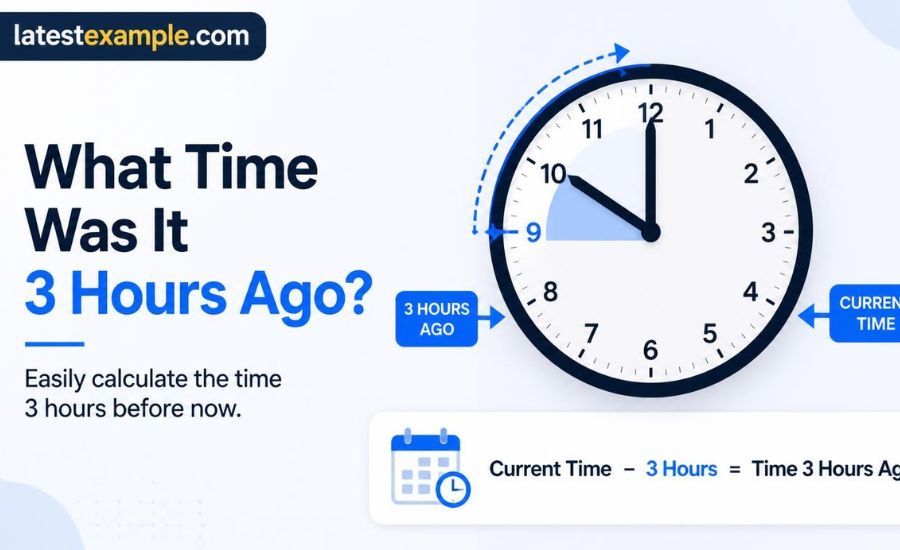
Finding out what time it was three hours ago is simple. You only need to subtract three hours from the current time. For example, if it is 6:00 PM now, it was 3:00 PM three hours earlier. If it is 2:00 AM now, it was 11:00 PM on the previous day.
Three hours equal 180 minutes or 10,800 seconds. Although the calculation is straightforward, the date, time zone, and AM/PM format can affect how you express the answer.
This guide explains how to calculate three hours ago, provides practical examples, and shows how to use a time calculator. It also covers GMT+5, common calculation mistakes, and the importance of checking the date when a calculation crosses midnight.
Related: What Time Is It 8 Hours From Now? A Simple Time Calculation Guide
How Can You Calculate What Time It Was 3 Hours Ago?
Calculating three hours ago requires simple subtraction. Start with the current time and move backward by three hours while keeping the minutes unchanged.
For example, if the current time is 7:45 PM:
- One hour earlier: 6:45 PM.
- Two hours earlier: 5:45 PM.
- Three hours earlier: 4:45 PM.
- Therefore, three hours before 7:45 PM was 4:45 PM.
What Is the Basic Formula for Subtracting Three Hours?
The basic formula is:
Time 3 hours ago = Current time − 3 hours
For example:
- 8:00 PM − 3 hours = 5:00 PM.
- 12:30 PM − 3 hours = 9:30 AM.
- 4:15 AM − 3 hours = 1:15 AM.
You can use this formula with either a 12-hour or a 24-hour clock.
How Do You Adjust the Date When the Calculation Crosses Midnight?

If the current time is earlier than 3:00 AM, subtracting three hours takes you into the previous calendar day.
For example, if it is 1:30 AM on Thursday, three hours earlier was 10:30 PM on Wednesday.
The calculation is:
1:30 AM − 3 hours = 10:30 PM on the previous day.
Always check the date when your calculation crosses midnight.
How Do You Calculate 3 Hours Ago on a 12-Hour Clock?
A 12-hour clock divides the day into two periods: AM and PM. To calculate three hours ago, subtract three from the hour while keeping the minutes unchanged.
For example:
- 10:00 AM becomes 7:00 AM.
- 3:30 PM becomes 12:30 PM.
- 8:15 PM becomes 5:15 PM.
- 2:45 AM becomes 11:45 PM on the previous day.
Pay attention when the calculation crosses noon or midnight. For example, three hours before 1:00 PM is 10:00 AM, while three hours before 1:00 AM is 10:00 PM on the previous date.
How Many Minutes Are There in 3 Hours?
Three hours contain 180 minutes.
One hour contains 60 minutes, so the calculation is:
3 × 60 = 180 minutes.
This conversion is useful when calculating work periods, appointments, travel durations, or short deadlines. For example, if an event started 180 minutes ago, it began three hours before the current time.
How Does a 3-Hours-Ago Calculator Work?
A three-hours-ago calculator takes a starting time and subtracts three hours. Depending on the tool, it may also consider the date and time zone to display a complete result.
The process generally works as follows:
- Enter the current date and time, or allow the calculator to use your device’s clock.
- Select the relevant time zone if necessary.
- Set the interval to three hours.
- Subtract the interval from the starting time.
- Display the earlier time and date.
For example, if you enter 6:30 PM, the calculator returns 3:30 PM on the same date. If you enter 1:30 AM, it returns 10:30 PM on the previous date.What Information Do You Need to Use a Time Calculator?
For a basic calculation, you only need the starting time. For a more precise result, especially when working with dates or international schedules, you may also need:
- The starting date.
- The starting time.
- The relevant time zone.
- The number of hours to subtract.
A calculator that supports dates and time zones is particularly useful for travel plans, business records, and events involving different locations.
How Does a Calculator Handle Changes in the Date?
A date-aware calculator automatically adjusts the calendar date when subtracting time crosses midnight.
For example, if the starting point is Friday at 2:00 AM, subtracting three hours produces Thursday at 11:00 PM.
Some locations also observe daylight-saving time. During a clock change, local clock readings can skip an hour or repeat an hour. The IANA Time Zone Database records these changes so compatible software can calculate local times more accurately.
When Should You Use a Time Calculator Instead of Mental Math?
Mental math is usually enough when subtracting three hours from a straightforward clock time. However, a calculator can help when the calculation involves additional details.
Use a time calculator when:
- You need the exact date and time.
- The calculation crosses midnight.
- You are comparing schedules in different time zones.
- A daylight-saving transition occurs during the interval.
- You are reviewing business records or event timestamps.
- You need to calculate several different time intervals.
For a simple calculation such as 7:00 PM minus three hours, mental math is faster. For more complicated calculations, a time-zone-aware calculator can reduce the chance of mistakes.
Why Do People Need to Know What Time It Was 3 Hours Ago?
People may need to calculate an earlier time for many everyday reasons. Knowing the exact time can help them determine when an event happened or how much time has passed.
Common examples include:
- Checking messages: Someone may want to work out when a message was sent three hours earlier.
- Work schedules: Employees can calculate when a task or work activity began.
- Travel planning: Travelers may compare departure times, arrival estimates, and local schedules.
- Online activities: Users may check when a post, comment, or other online event occurred.
- Appointments: A person may need to work out when an appointment or meeting started.
- Personal routines: People may calculate when they began studying, exercising, cooking, or completing another activity.
In each case, subtracting three hours provides a useful starting point. If the calculation crosses midnight, remember to adjust the date.
What Time Was It 3 Hours Before June 20, 2026?
June 20, 2026, is a specific date, but the exact time three hours earlier depends on the starting time. A date alone is not enough to produce one unique answer.
What Are the Common Mistakes People Make When Calculating 3 Hours Ago?
Even a simple subtraction can produce an incorrect answer if you overlook an important detail.
1. Subtracting the wrong number of hours
Make sure you subtract three full hours rather than three minutes or another interval.
2. Forgetting the previous date
If it is 1:00 AM, three hours earlier was 10:00 PM on the previous day, not 10:00 PM on the current day.
3. Confusing AM and PM
When using a 12-hour clock, check whether the calculation crosses noon or midnight.
4. Ignoring the time zone
A clock reading in one location may differ from the reading in another. Always use the correct time zone when comparing international events.
5. Overlooking daylight-saving changes
Some regions move their clocks forward or backward. This can affect the local clock reading during a three-hour elapsed interval. The IANA Time Zone Database provides information about historical and current time-zone rules.
6. Forgetting to check the result
A useful way to verify the answer is to add three hours to the calculated earlier time. You should return to the original starting time, accounting for any date or time-zone adjustment.
How Can You Calculate 3 Hours Ago Using an Analog Clock?

An analog clock can help you calculate three hours ago visually. Its hour hand moves around a circular dial, while the minute hand shows the minutes within each hour.
To find the earlier time:
- Look at the current positions of the hour and minute hands.
- Move the hour hand backward by three hour marks.
- Keep the minute hand at the same position.
- Check whether the movement crosses the 12 o’clock position.
- Adjust the date if the calculation moves into the previous day.
- For example, if an analog clock shows 8:20, moving the hour hand backward by three hour marks gives 5:20.
- If the clock shows 2:20 in the morning, three hours earlier was 11:20 PM on the previous date.
Why Can Three Hours Feel Different Depending on How We Remember Them?
Three hours always represent the same measured duration, but people may describe the experience differently. A period spent doing something enjoyable may seem to pass quickly, while waiting or completing a difficult task may feel longer.
This difference concerns how people experience and remember an interval, not a change in the actual number of minutes or seconds.
How Does Memory Affect Our Perception of Time?
People often estimate elapsed time by recalling activities and events. When looking back on a period, they may focus on what happened rather than calculating the exact number of minutes.
For example, someone who spent three hours watching a film, studying, or talking with friends may remember the period differently from someone who spent the same amount of time waiting for an appointment.
Memory can therefore influence how long an interval seems when people look back on it.
Why Can Three Hours Feel Shorter or Longer Than They Actually Are?
The experience depends on the situation and the individual. An engaging activity may make someone less aware of the passing minutes, while a repetitive task or long wait may make the same interval feel slower.
However, the measured duration does not change. Three hours remain 180 minutes regardless of how someone experiences them.
What Simple Formula Can You Use to Calculate 3 Hours Ago?
The easiest formula is:
Time 3 hours ago = Current time − 3 hours
You can also use a 24-hour clock to make subtraction easier.
Examples:
- 18:00 − 3 hours = 15:00.
- 14:30 − 3 hours = 11:30.
- 04:15 − 3 hours = 01:15.
- 02:00 − 3 hours = 23:00 on the previous date.
The 24-hour format removes the need to write AM or PM. However, you must still adjust the date when the calculation crosses midnight.
How Can You Find the Exact Time 3 Hours Ago?
Follow these steps to calculate the exact earlier time:
- Check your current local time.
- Write down the hour and minutes.
- Subtract three from the hour.
- If the result is below zero, add 24 to the hour and move to the previous date.
- Convert the result into AM/PM format if needed.
- Confirm the time zone if you are comparing different locations.
- For example, suppose the starting time is 2:40 AM on Friday.
- Starting time: 2:40 AM.
- Subtract three hours.
- Result: 11:40 PM.
- Adjust the date to Thursday.
- The exact answer is Thursday at 11:40 PM.
For ordinary local calculations, these steps are sufficient. If the interval crosses a daylight-saving clock change, use a calculator that accounts for the applicable time-zone rules.
What Are the Most Frequently Asked Questions About 3 Hours Ago?
How Do You Calculate What Time It Was 3 Hours Ago?
Subtract three hours from the current time. Keep the minutes unchanged and adjust the date if the calculation crosses midnight.
What Time Was It 3 Hours Ago From Now?
The answer depends on the current local time. For example, if it is 8:00 PM now, three hours ago was 5:00 PM.
How Many Minutes Are There in 3 Hours?
Three hours contain 180 minutes because one hour equals 60 minutes and 3 × 60 = 180.
What Happens If Calculating 3 Hours Ago Crosses Midnight?
The result moves into the previous calendar day. For example, three hours before 2:00 AM on Friday was 11:00 PM on Thursday.
What Are the Key Takeaways About Finding the Time 3 Hours Ago?
Finding the time three hours ago is a simple subtraction problem. Subtract three hours from the current time and keep the minutes unchanged.
If the calculation crosses midnight, move the date back by one day. When using GMT+5 or another time zone, begin with the correct local clock time. For more complicated calculations involving daylight-saving changes, use a time-zone-aware calculator.
What Important Facts Should You Know About 3 Hours?
- Three hours equal 180 minutes.
- Three hours equal 10,800 seconds.
- Three hours equal 10,800,000 milliseconds.
- One hour contains 60 minutes.
- One minute contains 60 seconds.
- Three hours before 6:00 PM is 3:00 PM.
- Three hours before 2:00 AM is 11:00 PM on the previous date.
- The minutes normally remain unchanged when subtracting a whole number of hours.
- A 24-hour clock can make time subtraction easier.
- Time-zone and daylight-saving rules can affect local clock calculations.
Can You Test Your Knowledge With These 3-Hour Calculation MCQs?
1. How many minutes are there in three hours?
A. 60
B. 120
C. 180
D. 240
Correct answer: C. 180
2. If the current time is 6:00 PM, what time was it three hours ago?
A. 2:00 PM
B. 3:00 PM
C. 4:00 PM
D. 5:00 PM
Correct answer: B. 3:00 PM
3. How many seconds are there in three hours?
A. 3,600
B. 7,200
C. 9,000
D. 10,800
Correct answer: D. 10,800
4. What time was it three hours before 2:00 AM?
A. 11:00 PM previous day
B. 12:00 AM same day
C. 5:00 AM same day
D. 11:00 AM previous day
Correct answer: A. 11:00 PM previous day
5. What is the basic formula for finding three hours ago?
A. Current time + 3 hours
B. Current time − 3 hours
C. Current time × 3
D. Current time ÷ 3
Correct answer: B. Current time − 3 hours
What Is the Summary of Calculating 3 Hours Ago?
To find out what time it was three hours ago, subtract three hours from the current local time. Three hours equal 180 minutes, 10,800 seconds, and 10,800,000 milliseconds.
For example, if it is 8:00 PM, the earlier time was 5:00 PM. If it is 2:00 AM, the earlier time was 11:00 PM on the previous day.
The simplest method is to subtract three from the hour while keeping the minutes unchanged. Always check the date when the calculation crosses midnight, and use the correct time zone for international comparisons.
You will be also read about Measurement latestexample