Introduction
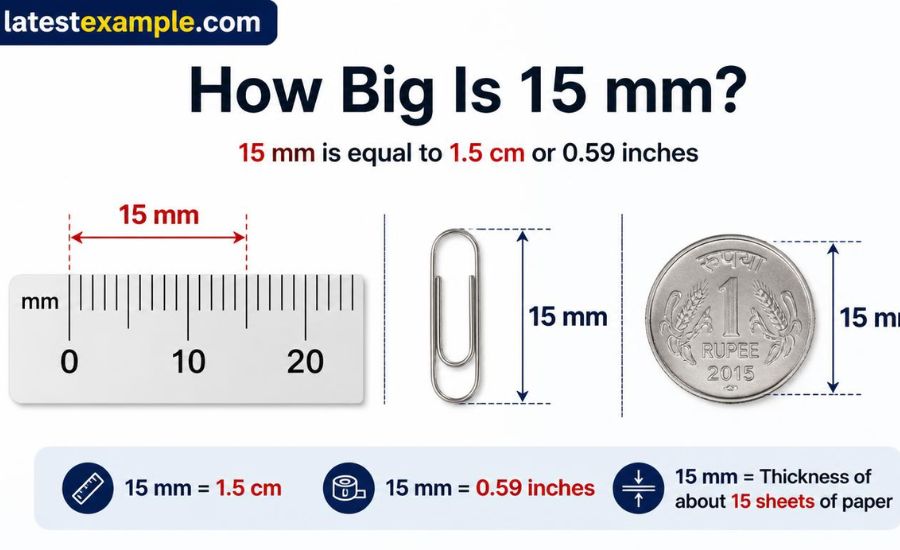
Fifteen millimeters is a small measurement, but it is large enough to see and compare with many everyday objects. If you have ever wondered how big 15 mm is, the easiest way to understand it is to convert the measurement into familiar units and visualize it using objects around you.
According to the National Institute of Standards and Technology (NIST), the inch is defined as exactly 25.4 millimeters. Using this conversion, 15 mm equals approximately 0.591 inches, which is a little less than five-eighths of an inch.
Fifteen millimeters also equals 1.5 centimeters. Imagine a short section of a ruler, a small button, or the width of a compact household item. These comparisons can help you develop a sense of the measurement, although the actual dimensions of individual objects vary.
Related: 4 Weeks From Today Explained: How to Calculate the Future Date Without a Calendar
Why Is Understanding 15 Millimeters Useful?
Knowledge of millimeters is important when measuring small objects, choosing hardware, doing craftwork, looking at specifications, and making comparisons. Millimeters are used in many different areas, from technical drawings to engineering.
Learning to recognize 15 mm also makes it easier to estimate other measurements. Once you understand how 15 mm compares with 5 mm, 10 mm, and 20 mm, you can make more informed estimates before reaching for a measuring tool.
How Big Is 15 mm?

Fifteen millimeters is equal to 1.5 centimeters or approximately 0.59 inches. It is less than one inch and measures just over half an inch.
These conversions are based on standard metric-to-imperial relationships. The inch conversion is rounded for everyday use.
What Are the Exact Dimensions of 15 Millimeters in Other Units?
The metric system uses prefixes to express different sizes of the meter. One centimeter contains 10 millimeters, so dividing 15 by 10 gives 1.5 centimeters. One meter contains 1,000 millimeters, making 15 mm equal to 0.015 meters.
To convert millimeters into inches, divide the millimeter value by 25.4:
15 ÷ 25.4 ≈ 0.5906 inches.
For practical measurements, you can round this result to 0.59 inches. If you need greater precision for a technical project, retain additional decimal places as appropriate.
How Can You Visualize 15 mm Using Familiar Objects?
A useful starting point is a metric ruler. Find the 1-centimeter mark, then continue another five small millimeter divisions. You will reach 15 mm, or 1.5 cm.
You can also compare the measurement with a small button, bead, or similarly sized object. These comparisons are approximate because everyday products come in different sizes.
The most reliable way to develop a visual reference is to measure a few familiar objects and remember which ones are closest to 15 mm.
How Can You Find 15 mm on a Ruler?
Finding 15 mm on a metric ruler is straightforward once you understand the markings. Most metric rulers show centimeters as numbered marks and millimeters as smaller divisions between them.
The National Institute of Standards and Technology provides educational resources, including its Metric Ruler (NIST SP 376), to help learners understand and read metric measurements.
How Do You Count Millimeter Marks to Locate 15 mm?
Follow these steps:
- Place the ruler on a flat surface.
- Find the zero mark at the beginning of the scale.
- Locate the 1-centimeter mark, which represents 10 mm.
- Count five additional millimeter divisions.
- Stop at the 15 mm mark, which is also 1.5 cm.
<text color=”secondary” size=”sm”>Remember: Each small millimeter division represents 1 mm, and every 10 mm equals 1 cm.</text>
If you are measuring an object, align one end with zero and read the mark at the opposite end. If the object does not start at zero, subtract the starting measurement from the ending measurement.
How Can You Read 15 mm on a Metric Ruler Accurately?
Keep the ruler straight and aligned with the object. Read the measurement at eye level to reduce viewing errors, and avoid measuring from the physical edge of a ruler if that edge is worn or does not align with zero.
If your ruler displays both inches and centimeters, make sure you are reading the correct scale. The inch and metric markings use different divisions, and confusing them can produce an incorrect result.
For greater precision, use a ruler with clear millimeter markings or a suitable measuring instrument designed for the object.
What Objects Are Approximately 15 mm Thick?
Thickness describes the distance between two opposite surfaces, rather than the length or width of an object. A small item can be 15 mm long but much thinner than 15 mm.
Objects with a thickness near 15 mm include some wooden craft pieces, compact plastic blocks, small spacers, and selected hardware components. Their dimensions depend on the product.
Which Common Materials and Small Items Can Measure Around 15 mm Thick?
A piece of wood cut to a nominal thickness of 15 mm is a direct example. Small plastic blocks, rubber spacers, and some craft materials can also be manufactured to this thickness.
When shopping for materials, check whether a listed dimension refers to thickness, width, length, or diameter. A product described as 15 mm wide is not necessarily 15 mm thick.
Why Should You Check an Object’s Actual Thickness Instead of Guessing?
Thickness matters when two parts must fit together. A spacer that is too thick may prevent a component from fitting, while a piece of material that is too thin may leave an unwanted gap.
For DIY projects, use calipers or a suitable ruler when a precise fit is required. Do not rely on visual comparisons for machine parts, electrical components, or other applications where dimensional errors could affect safety or function.
How Can You Measure 15 mm Without a Ruler?
You can estimate 15 mm without a ruler by comparing the target size with a known measurement. However, estimation is less reliable than direct measurement, especially when small differences matter.
Which Everyday Tools Can Help You Estimate 15 mm?
A measuring tape with millimeter markings, a digital caliper, or a measuring gauge can help you check a small dimension. If you have none of these tools, compare the object with a reference whose size you have already measured.
You can also mark a 15 mm section on paper using a properly scaled ruler and keep it as a temporary visual reference. Make sure the printed or drawn scale has not been resized.
How Can You Improve Measurement Accuracy Without a Measuring Scale?

If accuracy matters, obtain a suitable measuring tool rather than relying entirely on an estimate. For a rough comparison, place the object beside a known-size reference on a flat surface and align their starting edges.
Avoid using finger widths or other body measurements as exact standards because they vary between individuals. For technical work, a caliper is usually more suitable than visual estimation.
How Does 15 mm Compare With Centimeters, Inches, and Fractions of an Inch?
Fifteen millimeters is one and a half centimeters. In inches, it is approximately 0.591 inches, slightly less than 5/8 inch, which equals 0.625 inch.
The difference between 15 mm and 5/8 inch is about 0.87 mm. That difference may be small for a visual comparison but can matter when selecting precision components.
What Is the Difference Between 5 mm, 10 mm, 15 mm, and 20 mm?
The difference between each consecutive measurement in this sequence is 5 mm.
- 5 mm: Half a centimeter.
- 10 mm: One centimeter.
- 15 mm: One and a half centimeters.
- 20 mm: Two centimeters.
Each increase adds another 5 mm. This makes the sequence useful for estimating small dimensions and understanding how millimeter measurements relate to centimeters.
Where Are 15 mm Measurements Commonly Used?
A measurement of 15 mm can appear in crafts, household repairs, product specifications, manufacturing, and engineering. Its importance depends on the object and the tolerance required.
How Is 15 mm Used in Crafts, DIY Projects, and Household Repairs?
Craft projects may use 15 mm beads, buttons, spacers, and decorative components. In woodworking, a material may be sold with a nominal thickness close to 15 mm. Household repairs may also involve measuring the width or thickness of small fittings.
Before buying a component, confirm the dimension that matters. For example, a washer’s outer diameter, inner diameter, and thickness describe three different measurements.
Why Does a 15 mm Measurement Matter in Manufacturing and Product Specifications?
Manufacturing relies on defined dimensions to ensure that parts fit and function as intended. A 15 mm specification may describe a component’s diameter, thickness, length, or another linear dimension.
The National Institute of Standards and Technology emphasizes the use of consistent metric units and accurate measurement practices in its educational resources. In practical applications, the required tolerance determines how precise a measurement must be.
A rough estimate may be adequate for a craft project, but precision parts should be measured with appropriate instruments and compared with their technical specifications.
What Are the Most Common Mistakes When Estimating 15 mm?
Estimating a small dimension can be difficult when you do not have a reliable reference. Common mistakes include confusing units, measuring the wrong dimension, and assuming that similar-looking objects have identical sizes.
Why Do People Confuse Millimeters With Centimeters?
The symbols mm and cm look similar, but they represent different units. One centimeter equals 10 millimeters, so 15 cm is ten times as large as 15 mm.
Always check the unit printed beside a measurement. When converting between millimeters and centimeters, divide millimeters by 10 to obtain centimeters, or multiply centimeters by 10 to obtain millimeters.
How Can You Avoid Errors When Measuring Small Objects?
Use a clear measuring scale, align the starting point correctly, and measure the dimension you actually need. For round objects, distinguish between diameter and thickness. For rectangular objects, distinguish between length, width, and height.
If you are using a ruler marked in both metric and imperial units, check which scale you are reading.Where there is a need for accuracy, repeat the measurements or use a tool that suits the item.
What Important Facts Should You Know About 15 mm?
Fifteen millimeters is a short but useful measurement that can be expressed in several common units. The following facts provide a quick reference for everyday measurement tasks.
What Are the Key Conversions and Measurement Facts for 15 Millimeters?
- 15 mm equals 1.5 cm.
- 15 mm equals 0.015 m.
- 15 mm is approximately 0.5906 inches.
- 15 mm is slightly less than 5/8 inch.
- 10 mm equals 1 cm.
- A millimeter is one-thousandth of a meter.
- The exact relationship between inches and millimeters is 1 inch = 25.4 mm.
- These conversions follow the standard relationships documented by NIST.
Which Everyday Comparisons Make 15 mm Easier to Remember?
Remember that 15 mm is one and a half centimetersIn a metric ruler, it is the mark five small lines after the 1 cm mark.
You can also remember it as a little under 0.6 inches. Small buttons, beads, and similar craft components may provide useful visual comparisons, provided their actual dimensions are checked when accuracy matters.
What Frequently Asked Questions Can Test Your Knowledge of 15 mm? (MCQs)
1. How many centimeters are in 15 mm?
A. 0.15 cm
B. 1.5 cm
C. 15 cm
D. 150 cm
Correct answer: B. Fifteen millimeters equals 1.5 centimeters.
2. Approximately how many inches are in 15 mm?
A. 0.25 inches
B. 0.39 inches
C. 0.59 inches
D. 1.5 inches
Correct answer: C. Fifteen millimeters is approximately 0.591 inches.
3. Where is the 15 mm mark on a metric ruler?
A. Five divisions before the 1 cm mark
B. At the 1 cm mark
C. Five millimeter divisions after the 1 cm mark
D. At the 2 cm mark
Correct answer: C. Fifteen millimeters equals 10 mm plus another 5 mm.
4. Which statement about everyday objects measuring approximately 15 mm is correct?
A. Every small button measures exactly 15 mm.
B. All beads have the same diameter.
C. Everyday objects vary, so their dimensions should be checked.
D. Visual estimation is always exact.
Correct answer: C. Object dimensions vary by design and manufacturer.
5. How many millimeters are in 2 centimeters?
A. 2 mm
B. 10 mm
C. 20 mm
D. 200 mm
Correct answer: C. One centimeter equals 10 millimeters, so 2 cm equals 20 mm.
Summary: How Can You Remember the Size of 15 mm?
Fifteen millimeters equals 1.5 centimeters, 0.015 meters, and approximately 0.591 inches. It is slightly less than 5/8 inch and can be located on a metric ruler by counting five millimeter divisions beyond the 1 cm mark.
Small buttons, beads, spacers, and craft components may help you visualize the size, but their dimensions are not universal. Measure the actual item when accuracy matters.
The easiest way to remember 15 mm is to think of one and a half centimeters. That simple conversion makes it easier to estimate small dimensions, read a metric ruler, and understand measurements used in everyday projects.
You will be also read about Measurement latestexample